
 fejoneslive
Understanding how our interpretations shape communication, relationships, and the conclusions we accept as truth.
Every day, we form conclusions about people, conversations, and situations based on what we see, hear, and experience. We interpret someone’s words, observe their behavior, consider what we know about them, and decide what their actions mean. Much of this happens so naturally that we rarely stop to examine the thinking process involved. We simply accept our interpretation as an accurate account of what occurred.
But just because we believe something to be true doesn’t mean it is.
One of the things I believe we need to become more responsible for is learning to distinguish between what actually happened and what we’ve concluded happened. Those two things aren’t always the same, yet we often treat them as though they are. We can become offended by something that wasn’t communicated, assign motives to someone without sufficient evidence, or overlook inappropriate behavior because it doesn’t fit our established perception of that person.
This is where self-awareness, discernment, and personal responsibility become especially important. If we’re going to develop sound judgment, we need to examine more than the conclusions we reach. We also need to understand how we arrived at those conclusions in the first place.
I believe this is one of the practical areas where the renewing of our minds becomes necessary. Romans 12:2 speaks about transformation through the renewal of our thinking, but that transformation requires more than replacing negative thoughts with positive ones. It involves examining the beliefs, assumptions, and judgments that influence how we understand ourselves, other people, and the circumstances we encounter.
Psychology offers some useful explanations for how our minds interpret information and why those interpretations can sometimes be inaccurate. Scripture helps us understand the responsibility we have to exercise wisdom, humility, and sound judgment. Even philosophy, particularly certain principles found in Stoicism, contributes valuable questions about the relationship between our experiences and the meanings we assign to them.
When we examine these perspectives carefully, we begin to understand why learning to question our own interpretations is an important part of personal growth.
How Our Minds Interpret Information
Our minds don’t receive information without context. We interpret new experiences through what we already know, what we’ve learned, what we’ve experienced, and what we expect to happen. These mental processes help us recognize patterns, make decisions, and navigate our relationships without having to investigate every situation from the beginning.
However, the same processes that help us make sense of the world can also influence us to reach inaccurate conclusions.
Consider a situation where we send someone a message and receive a brief response. Depending on our previous experiences with that person, we might interpret their response as dismissive, irritated, or uninterested. Yet the words themselves may not communicate any of those things. The person may be occupied, tired, distracted, or simply communicating in their usual manner.
Of course, it’s also possible that the person is irritated. The issue isn’t whether we’re allowed to consider that possibility. The issue is whether we have enough evidence to accept it as fact.
Psychologists study this tendency through a concept known as interpretation bias, which describes how people may favor certain meanings when interpreting ambiguous information.
In a 2020 systematic review and meta-analysis published in the Journal of Affective Disorders, researchers Junwen Chen, Michelle Short, and Eva Kemps examined 44 studies involving 3,859 participants. Their findings demonstrated a substantial association between social anxiety and negative interpretations of ambiguous social situations.
The research doesn’t mean that everyone who misinterprets communication has social anxiety, nor does it suggest that negative interpretations are always inaccurate. What it demonstrates is that our psychological expectations can influence how we interpret information, particularly when the situation allows for more than one reasonable explanation.
This raises an important question. When we interpret another person’s communication, how much of the meaning comes from what they actually said, and how much comes from what we already believe, expect, or fear?
We need to recognize that our interpretations may be influenced by factors that have very little to do with the present interaction. A previous experience with criticism might cause us to anticipate criticism from someone else. A belief about our own competence might influence how we receive information. An established opinion about someone’s character might lead us to interpret otherwise neutral language negatively.
None of these possibilities automatically makes our interpretation wrong. But they give us good reason to examine it before deciding what another person meant.
The Difference Between Communication and Interpretation
One of the foundational principles of effective communication is understanding that words, context, and the way something is expressed contribute to meaning.
There’s a difference between someone sharing information, expressing an opinion, making a suggestion, issuing a command, and passing judgment. These are different forms of communication, and we need to recognize those distinctions if we want to interpret messages accurately.
Consider the difference between someone saying, “I came across an article about that subject and thought you might find it interesting,” and someone saying, “You need to educate yourself about that subject because you clearly don’t understand it.”
Both statements refer to information, but they communicate different things. The first offers something for consideration. The second makes an assumption about someone’s knowledge and directs them to take action.
Now imagine receiving the first statement but interpreting it as though the person had communicated the second. We might begin explaining how much we already know, defending our experience, or questioning why the person would assume we needed additional information.
Yet the original statement didn’t necessarily communicate any judgment about our knowledge.
We’ve introduced a meaning that wasn’t established by the words themselves.
This is why I believe we need to pay closer attention to the language people use, including the language we use ourselves. We should be able to recognize when someone is expressing a personal preference rather than criticizing ours, when they’re sharing an experience rather than prescribing a course of action, and when a genuine judgment or accusation has been communicated.
However, we also need to understand that meaning isn’t determined by individual words alone. Context matters. Tone matters. The relationship between the people communicating matters. Someone can communicate disrespect through sarcasm or implication without using an obvious insult. A statement that appears neutral when read independently may carry a different meaning within an established pattern of interaction.
Likewise, someone can communicate directly and firmly without being disrespectful.
The responsibility is to examine the communication as a whole rather than relying exclusively on the emotional response it produces.
And we must remember that intention and impact aren’t identical. Someone may not intend to offend us, yet their language may still communicate something inappropriate or harmful. Conversely, we may feel offended even when the available evidence doesn’t establish that an offense was communicated.
Both circumstances require discernment, and neither can be evaluated accurately if we refuse to examine what was actually said.
Why Our Perceptions of People Need to Be Examined
Something else worth considering is how quickly we form opinions about people based on their behavior.
We observe how someone communicates, responds to situations, or interacts with others, and we begin developing conclusions about their personality, motives, and character. These conclusions can help us make informed decisions, especially when we’ve observed the same behavior repeatedly.
But they can also become assumptions that influence how we interpret future interactions.
In social psychology, researchers study a process called spontaneous trait inference. This involves forming impressions about someone’s characteristics based on their behavior, sometimes without consciously intending to evaluate the person.
For example, we may observe someone speaking confidently and conclude that they’re arrogant. Another person observing the same behavior may conclude that they’re knowledgeable or comfortable expressing themselves. Neither interpretation necessarily tells us everything we need to know about that person’s character.
The difficulty becomes greater when we’ve already established a particular perception of someone.
Suppose we’ve repeatedly experienced criticism from an individual. Over time, we may begin expecting criticism whenever that person communicates with us. That expectation isn’t necessarily unreasonable. It may be based on legitimate experiences that have taught us to exercise caution.
But does that mean everything the person says to us is criticism?
Not necessarily.
A person who has demonstrated judgmental behavior in the past may still make a neutral statement in the present. Likewise, someone we’ve always considered kind, respectful, or trustworthy may communicate something inappropriate or harmful.
We need to be able to recognize both possibilities.
A 2019 study published in the Journal of Personality and Social Psychology examined how people update impressions after receiving additional information about someone’s behavior. Researchers Irmak Olcaysoy Okten, Erica Schneid, and Gordon Moskowitz found that participants could revise their positive or negative evaluations when new information changed the meaning of an earlier action. However, impressions concerning personality traits were more resistant to change and required more deliberate reconsideration.
That distinction is relevant to how we evaluate people in everyday life.
We may acknowledge that someone behaved differently in a particular interaction while continuing to hold an older perception of who they are. Sometimes that perception remains useful because the overall pattern hasn’t changed. Other times, the new information may be giving us a reason to reconsider our conclusion.
The problem arises when we become so committed to our perception that we stop allowing new evidence to inform it.
This is why I believe individual interactions deserve careful consideration. Every interaction provides information, and as those interactions accumulate, we begin recognizing patterns. The pattern is established through the individual behaviors we observe, not through assumptions we’ve decided to maintain.
Patterns should inform our judgment without becoming a substitute for examining the evidence in front of us.
We can recognize someone’s established behavior while still remaining open to the possibility that a particular interaction means something different. We can also acknowledge that people change and that our understanding of them may need to change accordingly.
That doesn’t require us to abandon boundaries or overlook legitimate concerns. It requires us to distinguish what we’ve observed from what we’ve assumed.
What Happens When Our Reactions Reveal Something About Us?
There is another part of this conversation that I believe deserves just as much attention, because it requires us to examine ourselves rather than focusing exclusively on the behavior of others.
Sometimes another person’s words or actions bring something within us to the surface. We may experience irritation, discomfort, offense, or disagreement, but the intensity of our reaction may not be explained entirely by what the person communicated.
Their behavior may have challenged a belief, expectation, personal standard, or judgment we’ve been carrying.
For example, suppose we strongly believe that accepting financial assistance from family members is a sign of irresponsibility. We encounter someone who openly receives help from their family, and we immediately begin questioning their maturity or independence.
But what exactly do we know about that person’s circumstances? Do we know why they’re receiving assistance, what arrangements exist within their family, or whether the support is temporary or ongoing?
More importantly, have we examined why we believe accepting assistance necessarily reflects irresponsibility?
Perhaps we’ve developed that belief because we were taught that responsible adults should never depend on others. Perhaps we’ve experienced circumstances that required us to become independent at an early age. Or perhaps we’ve observed genuinely unhealthy patterns of dependence and have begun applying that judgment to situations that aren’t necessarily comparable.
It’s also possible that our concerns are justified by additional information.
The point isn’t to assume our reaction is wrong. The point is to recognize that our interpretation may be influenced by beliefs we haven’t adequately examined.
In cognitive psychology, the mental structures that help us organize and interpret information are often discussed in relation to schemas. These frameworks develop through learning and experience and influence how we understand new situations.
Schemas are not inherently harmful. They’re essential to how we process information. But when we rely on them without examining whether they accurately apply to the present circumstances, we can reach conclusions that aren’t supported by the evidence.
This is one reason self-awareness requires more than recognizing how we feel. We also need to examine the beliefs and interpretations that may be contributing to those feelings.
We can know we’re offended without accurately understanding why. We can recognize that someone’s behavior makes us uncomfortable while remaining unaware of the assumptions influencing that discomfort.
And sometimes, another person becomes a mirror, revealing something within ourselves that needs attention.
That doesn’t mean every uncomfortable interaction is a reflection of our own unresolved issues. People can genuinely behave in ways that are disrespectful, manipulative, or harmful. Sometimes our reactions are appropriate responses to those circumstances. There are also situations where another person’s behavior is inappropriate while our own interpretation or response deserves examination.
Both can be true.
The responsibility is to distinguish between them rather than automatically assigning the entire problem to ourselves or to the other person.
What Psychology Teaches Us About Reexamining Our Interpretations
One psychological concept that helps explain why this process matters is cognitive reappraisal.
Cognitive reappraisal involves reconsidering how we interpret a situation, potentially changing its emotional significance. Instead of automatically accepting our first interpretation, we consider whether another explanation may be more accurate or better supported.
Psychologist James Gross has conducted extensive research on emotion regulation, including the differences between cognitive reappraisal and emotional suppression.
In his 2002 review published in Psychophysiology, Gross explains that reappraisal changes how a situation is understood, while suppression involves controlling the outward expression of an emotional response. The research he reviewed generally found reappraisal more effective than suppression for reducing emotional experience and expression.
That distinction matters because controlling our behavior doesn’t necessarily mean we’ve examined our thinking.
We can remain calm during an interaction while privately maintaining an inaccurate conclusion about another person’s intentions. We can avoid confrontation while continuing to believe someone deliberately insulted us, even when we’ve never established that their words communicated an insult.
We may have managed our outward response, but that doesn’t mean we’ve corrected our interpretation.
Cognitive reappraisal gives us another option. We can examine the evidence, consider alternative explanations, and determine whether our original conclusion still holds.
Of course, changing our interpretation should not mean forcing ourselves to believe something positive when the evidence suggests otherwise. Reappraisal is not an obligation to excuse harmful behavior or assume everyone has good intentions.
Sometimes, after examining the circumstances more carefully, we may determine that our original interpretation was accurate.
The value lies in our willingness to test that interpretation rather than automatically accepting it.
What Stoic Philosophy Contributes to Our Understanding
Long before modern psychology developed formal explanations of cognitive interpretation and emotional regulation, Stoic philosophers were examining the relationship between human judgment and experience.
Epictetus, whose teachings were preserved by his student Arrian, addressed this relationship in the Enchiridion. In Chapter 5, he argues that our judgments about circumstances play an important role in how those circumstances affect us.
His larger philosophy emphasizes examining our impressions and distinguishing between what is within our control and what is not.
There is something worth considering in that distinction. We cannot always control what another person says, how they behave, or what circumstances arise around us. But we can develop greater discipline in how we evaluate our impressions and decide what conclusions the available evidence supports.
However, I believe we need to be careful about how we apply this principle. We shouldn’t use Stoic philosophy to suggest that people cannot genuinely harm one another or that every painful experience is simply the result of an incorrect judgment.
Words and actions have consequences. Mistreatment, betrayal, manipulation, and abuse don’t become harmless because someone changes their interpretation of them.
What Stoic philosophy contributes to this discussion is the recognition that our judgments deserve examination. We need to understand the difference between the event itself and the meaning we’ve assigned to it.
Christian theology and Stoicism are not identical. Their understandings of God, human nature, virtue, and transformation differ in important ways. Nevertheless, we can acknowledge useful philosophical observations without treating the two traditions as interchangeable.
For those of us who approach these questions through Scripture, the responsibility to examine our thinking goes beyond managing our emotional responses. It becomes part of the broader responsibility to grow in wisdom, discernment, humility, and spiritual maturity.
Renewal of the Mind: Examining What Paul Actually Teaches
Romans 12:2 is frequently quoted when discussing the renewal of the mind, but I believe it’s important to examine the passage within its context rather than reducing it to a general instruction to think positively.
In Romans 12:1, Paul appeals to believers in view of God’s mercy and calls them to present their lives to God as an act of worship. He then instructs them not to conform to the patterns of the present age but to be transformed through the renewing of their minds.
The New Living Translation expresses the central instruction in Romans 12:2 this way:
“Let God transform you into a new person by changing the way you think.”
Paul connects this transformation to the ability to discern God’s will. The Greek verb dokimazō, used in this passage, carries the sense of testing, examining, and approving what has been evaluated.
The significance is that Paul isn’t presenting renewal of the mind as a superficial exercise in replacing unpleasant thoughts with pleasant ones. He’s addressing a transformation in how believers think, live, and exercise judgment in response to God’s mercy.
The immediate context becomes even more interesting when we continue into Romans 12:3.
Paul instructs his readers not to think more highly of themselves than they ought but to evaluate themselves with sober judgment.
That connection deserves our attention because it reminds us that spiritual maturity doesn’t eliminate our responsibility to examine our own thinking. If anything, it should make us more willing to consider whether our judgments are accurate.
We can have strong convictions and still misunderstand a situation. We can possess knowledge and still apply it incorrectly. We can be confident in our understanding of another person’s intentions and later discover that our interpretation was incomplete.
The renewing of our minds should influence how we approach those possibilities.
Scripture reinforces the importance of careful judgment in other passages as well.
Proverbs 18:13 warns against answering before listening, while Proverbs 18:17 illustrates how an account may appear convincing until additional examination takes place. These passages remind us that arriving at a conclusion before hearing and evaluating the available information can lead to error.
James 1:19 instructs believers to be quick to listen, slow to speak, and slow to become angry. Within the larger context of James’s teaching, this instruction concerns a receptive and obedient posture toward God’s Word. It also provides a useful principle for considering how we approach communication: listening requires us to give attention to what is being communicated rather than immediately reacting to what we assume it means.
We also find a related responsibility in Matthew 7:1–5, where Jesus addresses the danger of examining another person’s faults while failing to recognize our own.
Notice that Jesus doesn’t conclude His illustration by suggesting we should never recognize wrongdoing in another person. He emphasizes the need for self-examination so that we can see clearly.
And that’s a distinction I believe is essential to this entire conversation.
Self-examination does not require us to abandon discernment. It helps us exercise discernment with greater accuracy and humility.
We have a responsibility to recognize harmful behavior, establish appropriate boundaries, and hold people accountable when necessary. But we also have a responsibility to examine whether our own assumptions, judgments, and interpretations are influencing how we understand what others have communicated.
We cannot responsibly examine someone else’s behavior while treating our own thinking as though it is beyond examination.
Four Questions for Examining Our Thinking
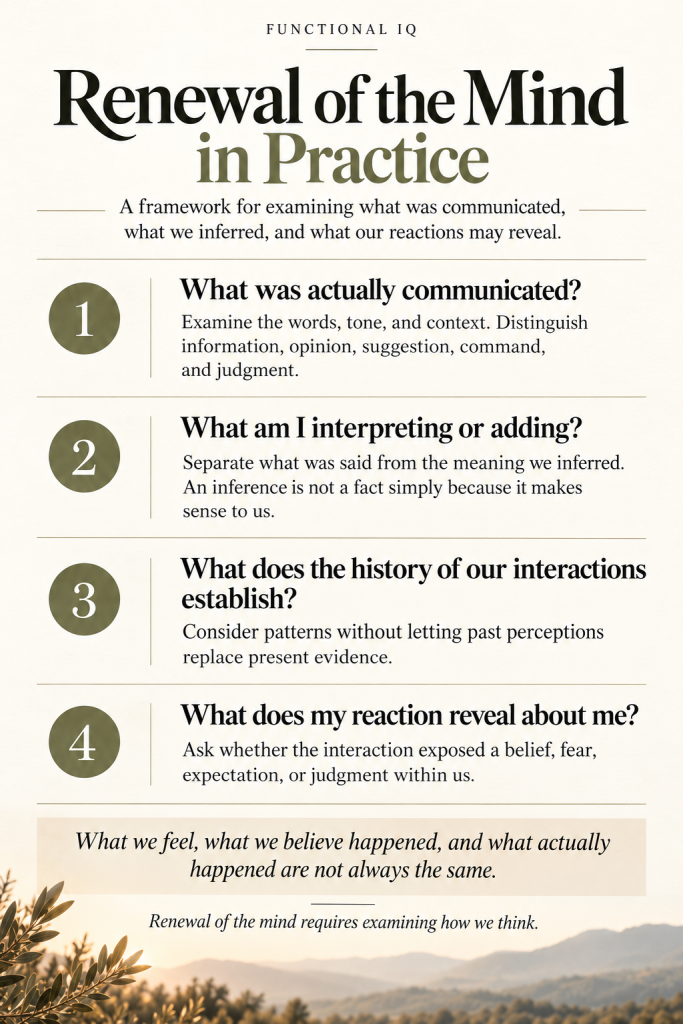
Bringing these ideas together, I’ve developed a four-question framework that can help us become more intentional about how we interpret communication and evaluate our interactions with others.
The framework isn’t intended to diagnose people’s motives or determine who is right or wrong in every situation. It’s a practical tool for examining what happened, recognizing what we’ve interpreted, considering established patterns, and identifying what our own responses may reveal.
1. What Was Actually Communicated?
Our first responsibility is to examine the communication itself. We need to consider what was said, how it was said, and the context in which it occurred.
Was the person sharing information, expressing an opinion, making a suggestion, issuing a command, or passing judgment? Did their language contain assumptions about our knowledge, character, or intentions? Did they communicate something that reasonably implied criticism or disrespect?
We also need to distinguish between the speaker’s intention and the meaning their words could reasonably communicate. Someone may not intend harm, yet their language may still be inappropriate. Likewise, we may experience discomfort even when the communication itself doesn’t establish that an offense occurred.
Before assigning motives or forming conclusions, we need to understand the communication we’re evaluating.
2. What Am I Interpreting or Adding?
Once we’ve examined the communication, we need to identify what we’ve concluded it means.
What evidence supports that conclusion? Are we assigning intentions the person never communicated? Are we interpreting the statement itself, or are we responding to expectations shaped by our previous experiences?
We should also consider whether another reasonable explanation exists.
This doesn’t mean searching for ways to excuse someone or talking ourselves out of legitimate concerns. It means recognizing that the first explanation our minds produce is not necessarily the most accurate one.
We need to learn to distinguish between what we observed, what we inferred, and what we have sufficient evidence to conclude.
3. What Does the History of Our Interactions Actually Establish?
Individual interactions provide the information from which we identify behavioral patterns. Over time, those patterns help us make decisions about trust, communication, relationships, and boundaries.
But an established pattern doesn’t mean every interaction must carry the same intention.
We need to examine whether the present behavior supports what we’ve previously observed, contradicts it, or simply doesn’t provide enough information to reach a conclusion.
Sometimes our perception of someone is accurate. Sometimes it’s incomplete. And sometimes the person has changed while we’ve continued relating to them through an older understanding of who they are.
Our responsibility is to consider the history without allowing it to replace the evidence in front of us.
4. What Does My Reaction Reveal About Me?
The fourth question requires us to examine our own thinking with the same seriousness that we examine someone else’s communication.
Why are we responding the way we are? Is our reaction connected to something actually communicated, or has the interaction brought one of our beliefs, expectations, fears, or personal judgments to the surface?
Could we be interpreting someone’s behavior through an experience we had with another person? Are we holding them accountable for violating a standard we’ve never thoroughly examined? Could their choices be challenging something within ourselves that we need to address?
We also need to leave room for the possibility that our reaction is appropriate because something genuinely harmful occurred.
Sometimes another person’s behavior needs to be addressed. Sometimes our interpretation needs to be reconsidered. And sometimes both require attention.
The objective is not to assign blame. It’s to understand what is happening accurately enough to respond responsibly.
Self-Awareness Is Not the Same as Accurate Understanding
One of the reasons I believe this framework matters is that we often speak about self-awareness without distinguishing it from accurate self-understanding.
We can recognize that we’re upset, offended, disappointed, or uncomfortable without fully understanding what produced those emotions. We may know exactly how we feel while remaining mistaken about another person’s intentions.
Likewise, we can recognize a genuine pattern in someone’s behavior while overlooking the patterns in our own thinking that influence how we interpret that person.
This is where we need to practice intellectual humility.
Being willing to examine our interpretations doesn’t mean we lack confidence or that we should constantly question our judgment. It means recognizing that our understanding is capable of error, just as anyone else’s is.
We can be certain about something and still discover that we were wrong.
We can have years of experience with someone and still misunderstand a particular interaction.
We can also believe someone has changed when the evidence demonstrates that an unhealthy pattern remains.
The responsibility is to examine what we know, consider what we don’t know, and remain willing to adjust our conclusions when the evidence requires it.
And when we discover that we’ve misunderstood someone, there may be another responsibility involved. We may need to correct not only our thinking but also the way we’ve treated that person because of our inaccurate interpretation.
That is part of accountability, too.
The Responsibility of Renewing Our Minds
Renewal of the mind is not simply about having better thoughts. It involves examining the beliefs, assumptions, and reasoning that influence how we understand the world and conduct ourselves within it.
When we look at the relationship between psychology, communication, philosophy, and Scripture, we can recognize a shared concern worth examining: the judgments we form about our experiences influence how we respond to them.
But those judgments aren’t always accurate.
We need to become more disciplined in distinguishing what someone communicated from what we’ve interpreted, recognizing patterns without allowing them to become permanent assumptions, and examining whether our own beliefs are influencing how we evaluate others.
None of this requires us to excuse harmful behavior or ignore legitimate concerns. Nor does it mean we should distrust every thought or emotion we experience.
It means learning to examine our understanding before treating it as established truth.
I believe this is one of the responsibilities that comes with spiritual and personal maturity. We should be willing to question our own interpretations with the same seriousness that we question the behavior of others. We should be willing to acknowledge uncertainty when the evidence is incomplete and correct our conclusions when we recognize that we’ve made an error.
Because if we’re unwilling to examine how we think, we may continue reinforcing beliefs that have never been adequately tested.
And if we’re unwilling to question the meanings we assign to other people’s words and actions, we may find ourselves holding them accountable for things they never actually communicated.
Renewing our minds requires more than changing what we think. It requires the humility and discipline to examine how we think, why we believe what we believe, and whether those beliefs are supported by truth.
That is a responsibility we all share, myself included.
References and Further Reading
Peer-Reviewed Psychology Research
Chen, J., Short, M., & Kemps, E. (2020). Interpretation bias in social anxiety: A systematic review and meta-analysis. Journal of Affective Disorders, 276, 1119–1130. https://doi.org/10.1016/j.jad.2020.07.121
Olcaysoy Okten, I., Schneid, E. D., & Moskowitz, G. B. (2019). On the updating of spontaneous impressions. Journal of Personality and Social Psychology, 117(1), 1–25. https://doi.org/10.1037/pspa0000156
Gross, J. J. (2002). Emotion regulation: Affective, cognitive, and social consequences. Psychophysiology, 39(3), 281–291. https://doi.org/10.1017/S0048577201393198
Ochsner, K. N., Bunge, S. A., Gross, J. J., & Gabrieli, J. D. E. (2002). Rethinking feelings: An fMRI study of the cognitive regulation of emotion. Journal of Cognitive Neuroscience, 14(8), 1215–1229. https://doi.org/10.1162/089892902760807212
Biblical Passages
Romans 12:1–3 — Transformation, renewal of the mind, discernment, and sober judgment.
Proverbs 18:13, 17 — Listening, examining information, and avoiding premature conclusions.
James 1:19–25 — Hearing, receiving, and responding to God’s Word.
Matthew 7:1–5 — Self-examination and the responsibility to exercise judgment with clarity.
Scripture discussed using the New Living Translation, with attention to the broader literary context.
Philosophical Reference
Epictetus. Enchiridion, Chapters 1 and 5. Teachings compiled by Arrian. These chapters address what lies within human control and the relationship between circumstances and the judgments formed about them.
English translation: https://epictetus-enchiridion.org/en/read/

