

 fejoneslive
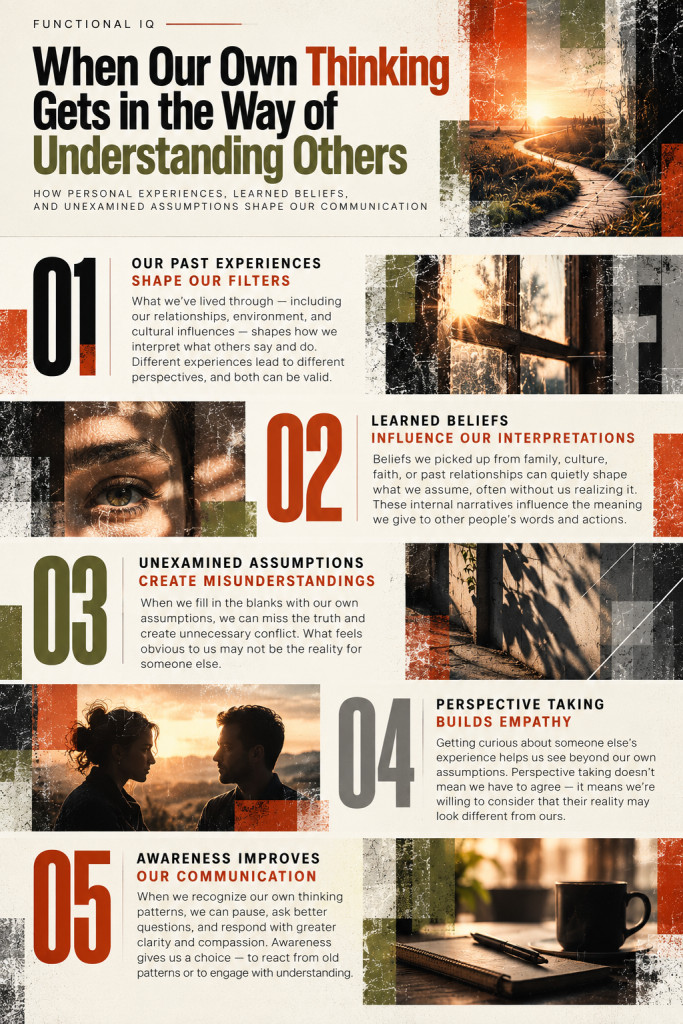
How personal experiences, learned beliefs, and unexamined assumptions shape our communication—and why renewing our minds matters for the relationships and generations that follow.
There is something about human communication that I believe we often underestimate. We can hear exactly what another person says and still respond to something they never communicated.
Sometimes we’re responding to our own assumptions. Other times, we’re responding to something we’ve experienced, something we’ve been taught, or something we’ve come to believe about how people should behave. We may not even realize we’re doing it.
And before we get too comfortable identifying the people in our lives who do this, I want us to include ourselves in the conversation. Because whether we recognize it or not, we’re all capable of allowing our own thinking to interfere with how we understand and respond to someone else.
This isn’t about labeling anybody, diagnosing their behavior, or making them feel as though something is wrong with them. That’s not why I’m bringing this up. My intention is to help us become more aware of the things that influence how we communicate, so we can recognize where we have opportunities to grow.
I want us to have better relationships. I want us to become better listeners, more thoughtful communicators, and people who understand that our experiences, preferences, and beliefs aren’t necessarily the standard by which everyone else’s lives should be measured.
And as a mother, I want us to consider something beyond our own relationships. What are we teaching our children about communication through the way we interact with other people? What patterns are we modeling without even realizing it?
Because whether we intend to or not, we’re teaching something.
Sometimes It’s as Simple as Pineapple Juice
Let’s start with something harmless.
Imagine we’re having a conversation, and I casually mention, “I love pineapple juice.”
You respond, “Pineapple juice is disgusting. I don’t know anybody who likes pineapple juice. People who drink that stuff are stupid.”
Now I’m standing there wondering how we went from me enjoying a glass of pineapple juice to an argument about the intelligence of people who drink it.
I didn’t ask you to like pineapple juice. I didn’t suggest that you should drink it. I didn’t make a claim about its superiority over another beverage. I simply told you something I enjoy.
Yet somehow my personal preference became an opportunity for you to express your judgment.
Now, you have every right to dislike pineapple juice. You might hate the taste, the smell, or everything about it. That’s perfectly fine. But why does my enjoyment of something you dislike require a negative judgment about me?
And why should your preference determine whether mine is acceptable?
There’s a difference between saying, “I’ve never liked pineapple juice,” and saying, “People who like pineapple juice are stupid.”
One communicates a personal preference. The other makes a judgment about people whose preferences differ.
The problem isn’t that we disagree. The problem is how we’re responding to that difference.
We can have different preferences without treating one another as though somebody needs correcting.
And sometimes we need to ask ourselves whether the opinion we’re about to express is even relevant to what the other person is communicating.
Not every thought we have needs to become part of the conversation.
Now, let’s change the circumstances.
Suppose we’re planning an event, and I mention that I love pineapple juice. You respond, “I know you enjoy pineapple, but we won’t be serving anything containing it because one of our guests has a serious pineapple allergy, and we need to make sure the event is safe for everyone.”
That’s entirely different.
You’re not challenging my preference. You’re addressing a legitimate safety concern that affects other people. We can discuss the appropriate precautions without making anyone’s personal taste a moral issue.
This distinction matters because we’re not trying to create a world where nobody is allowed to disagree, offer an opinion, or establish reasonable limits.
We’re learning to recognize the difference between a harmless personal preference and something that genuinely requires discussion, correction, accommodation, or intervention.
And while pineapple juice may seem like a silly illustration, the same communication problem can show up in situations with far greater consequences.
Your Experience Is Not the Measure of Someone Else’s Reality
Let’s move beyond preferences.
Suppose someone tells you, “I had a terrible experience at that restaurant.”
You respond, “That’s impossible. I’ve been eating there for years, and I’ve always had excellent service.”
But how does your positive experience establish that the other person’s negative experience couldn’t have happened?
Both of you could be telling the truth.
The restaurant may have treated you wonderfully every time you visited. Someone else may have encountered an employee having a difficult day, received poor service, or experienced something entirely different.
Your history with that restaurant doesn’t invalidate theirs.
Here’s a distinction I want us to understand:
There’s a significant difference between saying, “That hasn’t been my experience,” and saying, “That couldn’t have been your experience because it hasn’t been mine.”
The first acknowledges that our experiences differ. The second assumes that our experience establishes what another person could or could not have experienced.
And this is where communication begins to break down.
Sometimes we’re so confident in what we’ve experienced that we struggle to make room for what someone else is telling us.
We may do this in conversations about family, marriage, employment, friendships, education, religious communities, or any number of ordinary life experiences.
Someone says, “That working arrangement wasn’t healthy for me.”
We respond, “Well, everybody has to deal with difficult coworkers.”
But the person never said nobody should have to work with difficult people. They were describing something about their own circumstances.
Someone says, “I’ve decided not to attend those family gatherings anymore.”
We respond, “But that’s your family! Family is everything.”
Yet we haven’t asked why they made that decision. We don’t know their circumstances. We may not even know what kind of relationship they have with the people involved.
We have taken something the person communicated about their own life and redirected it toward our beliefs about what their life should look like.
That doesn’t mean we must accept every interpretation someone offers as an established fact. People can misunderstand events, make inaccurate assumptions, and draw conclusions that need further examination.
But there’s a difference between listening carefully while exercising discernment and dismissing someone simply because their experience doesn’t resemble ours.
We can take a person’s account seriously without pretending we know everything that happened.
We can ask questions without conducting an interrogation.
We can disagree with a conclusion without denying that someone had a different experience.
And we can acknowledge that our own experience, however meaningful, may not tell us the whole story.
What Psychology Tells Us About Our Thinking
Psychological research gives us several ways to examine why these communication patterns occur.
One is known as the false consensus effect. In a series of studies published in 1977, Lee Ross, David Greene, and Pamela House found that people tended to overestimate how common their own responses and choices were. They also sometimes viewed people who made different choices as more unusual.
Think about how easily we can turn “I don’t like that” into “Nobody likes that,” or “I would never do that” into “Something must be wrong with people who do.”
We’ve moved from describing our own perspective to making assumptions about other people.
Another relevant concept is intellectual humility. A 2022 review published in Nature Reviews Psychology describes intellectual humility in terms of recognizing the limitations of our knowledge and the possibility that our beliefs may be mistaken.
I want to be clear about something. Intellectual humility doesn’t mean having no convictions. It doesn’t mean constantly apologizing for what we believe or pretending every opinion is equally reasonable.
It means recognizing that we can know something without knowing everything.
We can have strong convictions and still acknowledge when we lack information.
We can be confident in our judgment while remaining willing to examine it.
And we can recognize that another person’s disagreement doesn’t automatically mean they’re ignorant, unreasonable, or disrespectful.
There’s another study I find especially interesting.
In 2018, researchers Tal Eyal, Mary Steffel, and Nicholas Epley published research examining whether imagining another person’s perspective actually improves our understanding of what that person thinks or feels.
Across 25 experiments, simply trying to imagine another person’s perspective did not consistently improve accuracy. In some cases, people became more confident in their judgments without becoming more accurate.
But obtaining information directly through conversation did improve accuracy in the study designed to test that difference.
Think about the implications.
We can sincerely believe we’re putting ourselves in another person’s shoes and still misunderstand them.
We can imagine what they’re thinking based on what we would think. We can assume how they’re feeling based on how we would feel. We can decide why they behaved a certain way based on what would motivate us.
And we can be wrong.
Sometimes the best way to understand another person’s perspective is to stop imagining what it must be and ask them.
These findings don’t mean that every poor response comes from the same psychological process. They help us recognize some of the ways our thinking can influence our interpretation.
That’s the distinction I want us to preserve throughout this discussion.
We’re examining possibilities, not assigning diagnoses.
What Have We Learned to Consider Normal?
Not everything influencing our communication comes from an individual wound or painful experience.
Some of our expectations come from what we learned growing up, the communities we belong to, and the behaviors we’ve repeatedly seen modeled around us.
Imagine growing up in a household where the prevailing attitude was, “My way or the highway.”
Perhaps questioning a decision was treated as disrespect. Maybe one person always had the final word, and everyone else was expected to comply.
Over time, someone raised in that environment might come to associate authority with control or disagreement with defiance.
Now imagine a different environment.
Suppose you grew up feeling as though your thoughts and opinions were constantly dismissed. Every time you tried to express yourself, someone interrupted, criticized, or silenced you.
You may eventually decide, “Nobody is ever going to silence me again.”
That decision might help you develop the courage to speak up. It could become an important part of learning to advocate for yourself.
But what happens if you begin interpreting every disagreement as an attempt to silence you?
What happens when your determination to be heard becomes so strong that other people struggle to be heard around you?
The two individuals in these examples could develop similar communication habits for very different reasons.
One may have learned that controlling conversations is normal. Another may have come to believe that forceful communication is necessary to protect their voice.
Neither outcome is inevitable. Many people with those backgrounds develop healthy communication skills. These are possibilities to examine, not explanations we can automatically assign to someone based on how they speak.
And there are other influences to consider.
Some people have developed a habit of offering unsolicited judgments. Some respond impulsively. Some struggle to tolerate disagreement. Others may be experiencing stress, fatigue, or an emotionally difficult period.
Still others may deliberately attempt to dismiss or control people.
We shouldn’t pretend intentional mistreatment doesn’t exist. But we also shouldn’t assume malicious intent every time someone communicates poorly.
Research on social norms adds another dimension. Studies examining how children interpret group behavior have found that they can sometimes treat what members of a group commonly do as evidence of what members ought to do.
That’s important because what we repeatedly experience as normal can begin to feel like a rule everyone should follow.
But just because something was normal in our family doesn’t mean it was healthy.
Just because a communication pattern was accepted in our community doesn’t mean it was respectful.
And just because we’ve been doing something for years doesn’t mean it’s worth continuing.
What we learned to consider normal deserves examination, especially when it affects how we treat other people.
When Our Internal Responses Become Someone Else’s Problem
Here’s another issue we need to address.
Sometimes we’re not responding to what someone actually communicated. We’re responding to what we believe their words mean about us.
Someone asks a question, and we interpret it as a challenge to our intelligence.
Someone expresses a different opinion, and we interpret it as disrespect.
Someone makes a decision we wouldn’t make, and we treat it as though they’re criticizing our choices.
Someone prefers working independently, and we assume they don’t value teamwork.
But did they actually communicate those things?
Or did we assign those meanings ourselves?
Our emotional responses can give us valuable information about what we’re experiencing internally. But feeling challenged doesn’t automatically establish that someone challenged us. Feeling disrespected doesn’t necessarily mean disrespect occurred.
Sometimes our interpretation is accurate. People do make insulting comments, manipulate conversations, and deliberately undermine others.
The responsibility is to examine the available evidence rather than treating every emotional response as conclusive proof of another person’s intentions.
This is especially important for those of us in positions of influence or authority.
As parents, supervisors, ministry leaders, teachers, business owners, and community leaders, our responses can affect whether other people feel comfortable asking questions, expressing concerns, or sharing information.
If every question becomes a challenge to our authority, people may eventually stop asking.
If every difference becomes an argument, people may become reluctant to share their thoughts.
And if people repeatedly have to defend themselves against meanings they never intended, communication can become exhausting.
Leadership doesn’t exempt us from examining ourselves. If anything, authority gives us additional reasons to be careful about how our interpretations influence our conduct.
But this isn’t just for leaders.
It’s for all of us.
The Difference Between Being Heard and Having to Be Agreed With
I want us to examine another distinction that can quietly affect our relationships.
Being heard is not the same as being agreed with.
Someone can listen to you attentively, understand exactly what you’re saying, and still reach a different conclusion.
That doesn’t automatically mean they’ve dismissed you.
Likewise, someone can agree with you simply to end a conversation without ever genuinely considering what you said.
We need to stop treating agreement as the only acceptable evidence of understanding.
You have the right to your opinions, values, preferences, and personal decisions. So does the person sitting across from you.
That doesn’t mean we abandon moral standards, refuse to correct harmful behavior, or pretend every choice has the same consequences.
It means we understand the difference between allowing another person to make an independent choice and attempting to control them because their choice differs from ours.
For example, someone may choose a lifestyle we wouldn’t choose. We can maintain our convictions without making every interaction an opportunity to argue about theirs.
Someone may enjoy something we dislike. We can allow them that enjoyment.
Someone may have an experience we don’t understand. We can listen without immediately imposing our explanation.
And where there are shared responsibilities, genuine harm, legitimate boundaries, or safety concerns, we can address those matters directly and respectfully.
The question isn’t whether we’re allowed to express an opinion. Of course we are.
The question is whether we’re exercising sound judgment about when, why, and how we express it.
Having an opinion doesn’t automatically make expressing it necessary or appropriate.
Self-Awareness Is Not Self-Condemnation
This part is especially important to me.
I don’t want you to read this article and begin identifying everything you believe is wrong with you.
That’s not why we’re here.
As a mother, one of the things I’ve consistently tried to communicate to my children, even as they’ve grown into adulthood, is that correction is not condemnation.
When I address a behavior, I’m not telling them they’re bad people. I’m not saying they’re incapable or that my love for them has changed.
I’m addressing a particular action because I know they’re capable of making better choices.
My disappointment may be with a behavior, but that doesn’t mean I’m disappointed in who they are.
There’s a difference.
And I want us to understand that difference when we examine ourselves.
Suppose you recognize that you dismissed someone during a conversation.
You could respond by telling yourself, “I’m such a terrible person. I always mess things up. I don’t know how to treat people.”
But how does that help you understand what happened or what needs to change?
You’ve taken a specific behavior and turned it into a sweeping judgment about your identity.
Now consider a different response.
“I interrupted someone. I made an assumption about what they meant, and I responded without understanding. That wasn’t appropriate. I need to examine why I did that and make a different choice next time.”
Now you have something you can work with.
Research on shame and guilt has long examined the distinction between negative evaluations of the whole self and evaluations of particular behaviors. These are complex emotional experiences, but the distinction is useful for understanding why the way we interpret our mistakes matters.
When we confuse accountability with condemnation, admitting we were wrong can begin to feel like admitting we’re fundamentally bad.
And when that happens, we may become more concerned with defending ourselves than correcting the behavior.
I’m not telling you to excuse yourself. If your behavior harmed someone, there may be an apology to make, trust to rebuild, or consequences to accept.
But you don’t need to destroy your sense of worth to acknowledge that you made a poor choice.
And we need to extend that same distinction to how we correct others.
We can tell someone their behavior was inappropriate without diagnosing their personality or assigning motives we haven’t established.
We can address a repeated pattern without declaring that person incapable of change.
We can be firm about boundaries without humiliating someone.
Sometimes people will still become defensive. We cannot control how everyone receives correction. But we can take responsibility for communicating truthfully without adding unnecessary contempt, ridicule, or shame.
Accountability should help us recognize what needs to change, not become an excuse to condemn ourselves or someone else.
Renewal of the Mind Is More Than Changing What We Think
Now I want to bring us to something that is foundational to how I understand personal growth: the biblical principle of renewing the mind.
Romans 12:2 calls believers away from conformity to the world’s patterns and toward transformation through renewed thinking.
I think it’s important to read that instruction in its larger context.
Paul doesn’t stop at renewed thinking as an isolated spiritual concept. As Romans 12 continues, he addresses humility, honest self-evaluation, the different functions and gifts within the body of Christ, genuine love, honoring others, and the way believers should conduct themselves in their relationships.
Notice the connection between transformation and conduct.
Renewed thinking is not meant to remain an intellectual exercise.
It should influence how we live.
We see a related instruction in Ephesians 4:23:
“Instead, let the Spirit renew your thoughts and attitudes.” — NLT
The surrounding passage addresses putting away former ways of living and developing new patterns of conduct. Paul goes on to discuss speech, anger, honesty, kindness, and forgiveness.
He’s not presenting a contemporary psychological theory, and I don’t want to pretend he is.
But the biblical principle is clear: spiritual renewal is connected to how we live and treat other people.
We cannot claim to be growing in maturity while refusing to examine the behaviors that continue harming our relationships.
And this is where I believe our responsibility toward future generations becomes especially important.
Many of us grew up around patterns we didn’t choose.
Perhaps anger was the primary way people communicated disagreement. Maybe children weren’t allowed to ask questions. Perhaps apologizing was considered weakness, or someone’s authority meant they never had to explain themselves.
Some of those patterns may have been passed down through generations.
We often refer to destructive inherited patterns as generational curses. I recognize that Scripture addresses generational consequences and personal accountability in ways that deserve careful theological distinction. Not every harmful family tradition should be described as a literal spiritual curse.
But there is something very practical we can recognize: we do not have to continue passing along every dysfunctional behavior we inherited.
We can examine what we were taught.
We can compare it with the values and convictions we claim to hold.
We can recognize where our behavior contradicts those convictions.
And we can begin practicing something different.
This is renewal of the mind in action.
Not merely learning a new concept, but allowing changed understanding to influence our choices.
And I want to be clear: recognizing a pattern doesn’t automatically break it. Some behaviors are deeply established. They may require repeated practice, honest accountability, and sometimes professional support.
But we cannot intentionally change what we’re unwilling to examine.
What the Bible Says About Listening Before Speaking
One of the most direct passages I’ve found for this discussion is Proverbs 18:2:
“Fools have no interest in understanding; they only want to air their own opinions.” — NLT
That’s a strong statement, and I don’t think we need to soften it.
The proverb contrasts an interest in understanding with an interest in expressing one’s own opinions.
Think about how often we enter conversations already preparing our responses.
Someone begins talking, and before they’ve finished, we’re thinking about our own experience, our disagreement, our advice, or what we want to say next.
But have we actually understood them?
Proverbs 18:13 addresses the folly of answering before listening to the facts. These wisdom sayings don’t require us to remain silent when something genuinely needs addressing. They challenge the habit of responding without sufficient understanding.
James 1:19 similarly calls believers to listen readily, exercise restraint in speaking, and avoid quick anger. In context, James is addressing the kind of receptive and obedient life believers are called to practice, not merely offering a public-speaking technique.
Still, its practical relevance to our relationships is difficult to miss.
Listening requires more than remaining quiet while somebody else speaks.
We need to consider whether we’ve accurately understood the meaning of their words before deciding what our response should be.
And there’s a related observation from Stoic philosophy.
In Section 5 of his Enchiridion, Epictetus emphasizes the influence of our judgments on how we experience events.
His philosophy has its own assumptions and should not be treated as identical to biblical teaching or modern psychological research. But his emphasis on examining our judgments gives us another reason to consider whether our interpretation is justified.
A question, for example, is an event within a conversation.
Deciding that the question was intended to embarrass us is an interpretation.
Sometimes that interpretation may be correct. Sometimes it may not.
The responsibility is to learn the difference.
Examining Our Own Communication Patterns
I want to give you some questions to consider, and I encourage you to approach them with honesty rather than judgment.
You don’t need to answer every question. Not every possibility will apply to your life. And these questions aren’t a psychological assessment or a way to diagnose yourself.
They’re an opportunity to become more aware of the experiences, beliefs, and habits that may influence your communication.
Consider the following:
- What did I learn growing up about disagreement, authority, and the right to express an opinion? Was disagreement welcomed, discouraged, or treated as disrespect?
- Have I experienced situations where my voice was repeatedly dismissed or silenced? If so, how might those experiences influence the way I respond when someone disagrees with me today?
- When someone expresses an opinion or preference different from mine, do I feel compelled to explain why mine is better? What am I hoping to accomplish by doing that?
- Have I ever treated my positive experience with a person, place, or institution as evidence that someone else’s negative experience couldn’t be true?
- Do I sometimes confuse someone disagreeing with me with someone disrespecting me? How do I determine the difference?
- Are there family traditions, cultural expectations, or personal beliefs I’ve accepted as universal standards without examining whether they’re appropriate for everyone?
- When someone shares a personal experience, am I listening to understand what happened to them, or am I mentally preparing to compare it with what happened to me?
- Do I ask clarifying questions before drawing conclusions about another person’s intentions?
- When I recognize that I’ve communicated poorly, am I willing to acknowledge the behavior and correct it, or do I become defensive because admitting a mistake feels threatening to my identity?
- What communication patterns am I modeling for my children, family members, coworkers, or the people I influence? Are those patterns ones I would want them to carry into their own relationships?
You may discover that some patterns have roots in your upbringing. Others may be connected to past experiences, deeply held expectations, or habits you developed over time.
You may discover that you communicate well in certain environments but become defensive in others.
Or you may realize that something you’ve considered part of your personality is actually a behavior you can learn to manage differently.
Whatever you discover, the purpose isn’t to give yourself a negative label.
It’s to recognize where you have an opportunity to grow.
Awareness Has to Lead Somewhere
I want to leave you with a practical way to begin using what we’ve discussed.
The next time you notice yourself having a strong response to something another person says, examine what is happening before you automatically act on it.
Start with what the person actually communicated.
Then consider what you understood them to mean.
Ask yourself whether you have evidence for that interpretation or whether you’ve filled in missing information with your own assumptions.
If something is unclear, ask.
If you disagree, determine whether disagreement is relevant to the conversation and communicate it respectfully.
If there’s a legitimate boundary, safety concern, or harmful behavior that needs addressing, address it directly without unnecessarily attacking the person.
And if you recognize that you’ve made an unfair judgment or misunderstood someone, acknowledge it.
We don’t lose our dignity by admitting we were wrong.
We demonstrate something important when we’re willing to correct ourselves.
Research on reflective reasoning offers some encouragement here. In two experiments published in 2021, researchers found that practicing a more distanced form of self-reflection improved measures of wise reasoning about interpersonal challenges.
That doesn’t mean one moment of reflection will eliminate every bias or communication problem. It suggests that how we examine our experiences matters, and that wiser patterns of reasoning can be practiced.
We don’t have to respond to every thought or emotion as though it deserves immediate expression.
Sometimes we need to listen longer.
Sometimes we need to ask another question.
Sometimes we need to acknowledge that another person’s circumstances are different from ours.
And sometimes we need to recognize that the problem wasn’t what the other person said. It was what we decided their words meant.
What Are We Passing Along?
As we come to the end of this discussion, I want us to think about what kind of relationships and homes we’re building through our everyday communication.
Our children don’t learn only from the instructions we give them. They also observe how we respond when we’re questioned, corrected, disappointed, or confronted with a different point of view.
What do they see when someone disagrees with us?
Do they see us become defensive and dismissive?
Do they see us ridicule people whose preferences differ from ours?
Or do they see adults who can communicate their convictions, acknowledge mistakes, respect differences, and address inappropriate behavior without humiliating someone?
We cannot control everything our children learn or every influence they’ll encounter. But we do have responsibility for the examples we place before them.
And that responsibility doesn’t disappear when our children become adults.
The way we communicate continues to teach something.
I don’t expect any of us to get this right every time. I certainly don’t place myself outside the need for self-examination.
We’re human. We make assumptions. We misunderstand people. We react poorly. Sometimes we allow old experiences or established beliefs to influence our responses in ways we don’t immediately recognize.
The question is what we’re willing to do when we become aware of it.
Are we willing to examine ourselves without condemning ourselves?
Are we willing to recognize that another person’s experience can be different from ours without feeling compelled to dismiss it?
Are we willing to let people have their own preferences, make their own decisions, and express their own thoughts without unnecessarily policing them?
And are we willing to change the behaviors we’ve learned rather than automatically passing them along?
Because if we want healthier relationships and a better world for the generations coming behind us, we have to be willing to examine what we’re contributing to the relationships and environments we occupy right now.
I haven’t shared any of this because I believe I’m better than you or because I want you to walk away feeling judged.
I’m sharing it because I care about what happens to us, to our relationships, and to the people who are learning from how we live.
I believe we can be honest about behavior that needs correction without condemning the person. I believe we can hold strong convictions while allowing other people to have their own perspectives. And I believe we’re capable of learning healthier ways to communicate than some of the patterns we may have inherited.
But that growth requires our participation.
We cannot change the patterns we refuse to examine, and we cannot expect future generations to practice healthier ways of relating if we’re unwilling to question the behaviors we’ve normalized in our own lives.
That’s where renewal of the mind becomes more than something we talk about.
It becomes something we practice.
And eventually, something the people around us can experience.
Research References and Further Reading
The psychological findings discussed in this article come from the following publications. They provide evidence concerning particular aspects of social perception, perspective-taking, norms, humility, emotion, and reflective reasoning. No single study establishes every aspect of the argument.
- Ross, L., Greene, D., & House, P. (1977). The false consensus effect: An egocentric bias in social perception and attribution processes. Journal of Experimental Social Psychology, 13(3), 279–301. https://doi.org/10.1016/0022-1031(77)90049-X
- Eyal, T., Steffel, M., & Epley, N. (2018). Perspective mistaking: Accurately understanding the mind of another requires getting perspective, not taking perspective. Journal of Personality and Social Psychology, 114(4), 547–571. https://doi.org/10.1037/pspa0000115
- Porter, T., Elnakouri, A., Meyers, E. A., Shibayama, T., Jayawickreme, E., & Grossmann, I. (2022). Predictors and consequences of intellectual humility. Nature Reviews Psychology, 1, 524–536. https://doi.org/10.1038/s44159-022-00081-9
- Roberts, S. O., Gelman, S. A., & Ho, A. K. (2017). So it is, so it shall be: Group regularities license children’s prescriptive judgments. Cognitive Science, 41(S3), 576–600. https://doi.org/10.1111/cogs.12443
- Tangney, J. P. (1991). Moral affect: The good, the bad, and the ugly. Journal of Personality and Social Psychology, 61(4), 598–607. https://doi.org/10.1037/0022-3514.61.4.598
- Grossmann, I., Dorfman, A., Oakes, H., Santos, H. C., Vohs, K. D., & Scholer, A. A. (2021). Training for wisdom: The distanced-self-reflection diary method. Psychological Science, 32(3), 381–394. https://doi.org/10.1177/0956797620969170
Biblical passages
Romans 12:1–21; Ephesians 4:22–32; Proverbs 18:2, 13, 17; James 1:19–20.
Direct quotations are from the New Living Translation (NLT).
Philosophical reference
Epictetus. Enchiridion, Section 5. English translation available through Tufts University’s Perseus Digital Library: https://www.perseus.tufts.edu/hopper/text?doc=Perseus:text:1999.01.0237:text=enc:chapter=5

